Wednesday, July 19, 2017

Rilla of Ingleside: The Grand Finale.

   How do you do, 

   Some of y'all may remember the Harry Potter books where J.K. Rowling had us all waiting to find out if Harry and Lord Voldemort will have their climatic show down through seven books, which became eight movies with Warner Brothers' touch. Or with The Hunger Games where we waited for three (four in movies) to find out if they will ever over throw Panam. L. M. Montgomery didn't plan it so, but she had readers of the time waiting for years before a more recent event like World War I entered her writing. If you were to read the completed series today, you'd may have waited through Anne of Green Gables, Anne of Avonlea, Anne of the Island, Anne of Windy Poplars, Anne's House of Dreams, Anne of Ingleside, Rainbow Valley, and finally Rilla of Ingleside.
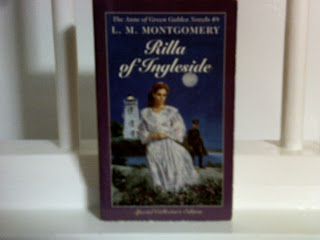
    In Rainbow Valley, we didn't have a clear protagonist, but instead had a bunch of children getting into trouble and causing adventures, which was sad when our main star is fading into the background. That is fixed in this book. We now have a protagonist, Bertha Marilla Blythe, or Rilla. The roly poly girl who was called "Spider" by her siblings and spoke with a lisp, is the one this book will center on as her brothers and sisters are grown up. Jem has been to college, as had Walter, and Shirley is getting into the academy. Nan and Di are also grown up. So, that puts us into learning of Rilla, in a manner of Seventh Heaven would have us focusing on Ruthie after all the Camden children have departed.
   Of course, Anne is still in the story, as she is Rilla's mother. Gilbert is still there, as is Miss Cornelia, and Mr. Douglas. We find out in the backstory that Marilla has finally died, thus ending the final link to Anne of Green Gables. No doubt, Rachel Lynde has also passed on, since nothing more is mentioned of her. It is also disappointing that Diana is rarely seen in these recent books. As to the Rainbow Valley bunch, besides the Blythe children we still have the Merediths, still have Mary Vance, and we have Owen Ford's son, Kenneth, or Ken, as he is often called. John Meredith, however, has retired as minister in the local church and his post is now occupied by Reverend Pryor, referred to as Whiskers On the Moon in the book due to his largely bald head with a mustache. According to the women, it seemed a group of boys came up with the name. From the start, the women don't consider Pryor to be fit to be elder and it won't end at this point. There's also the cat named Doc, short for Doctor Jekyll / Mister Hyde. The cats that Anne once had have died and Rilla had gotten a new one that she named Jack Frost, who then had kittens, and Doc is one them. Walter named him after Robert Louis Stevenson's book, and he shows the bipolar nature well. He goes back and forth between the two over the course of the book. Also returning is Dog Monday, the dog that Jem is attached to.

   The book opens with the same gossip that Anne absorbs before the main story begins. Susan Baker returns to read the Glen Notes, which mention the Assassination of Archduke Francis Ferdinand in Sarajevo. Montgomery lets us know that this would effect everyone, yet when the news came out hardly anyone took notice. Susan sniffs in thought that everyone is getting killed in the Balkans while the ladies agree it doesn't concern them. Thinking on recent events, I have seen real life examples of people who have heard of some tragedy overseas and not take notice, even though history is being made. Today, people are just posting selfies on Pinterest or tweeting on Twitter, while watching some favorite show on Netflix, and reading this blog, I see (just wanted to see if you were paying attention). That to me shows the sad reality; we have the technology to know of the news overseas much better than the women of Glen St. Mary did, and yet the indifference is still there.
    They all keep their minds on what's at home, especially Rilla who is going to a dance at the Four Winds Lighthouse. There, she intends on getting to dance with and even have her first kiss with Ken Ford. Of course, the whole thing doesn't turn out so well. She got a few partners until she spoke with Ken who calls her "Rilla-my-Rilla", a pet name that her brother and a friend use. Apparently, it's enough to make her fall in love with him, because that is what happens. Then, she loses her shoes, winds up dancing with others after Ken departs, and has to walk home bare footed when the party breaks up, as she left her shoes behind. (on that note, given how people had some thoughts going up when two young people disappear into the night and reappear minutes later, the missing shoes would have done some scandal). Symbolically, the loss of her shoes and having her feet all bruised can be likened to virginity loss, however, that is missing the mark: Rilla is taking her first steps on a hard road to adulthood, which is about to get even harder.
   Then came the Great War which we never get to see any of the battles or the gloom, but it does occupy the plot of the novel. For a refresher, a month after Archduke Francis Ferdinand was assassinated, his country, Austria-Hungary, declared war on Serbia. Serbia's ally, Russia, then mobilized against Austria-Hungary, prompting her ally, Germany, to declare war on Russia, and then France as they were allies. Then Germany invaded Belgium to flank the French Army. The British then declare war to protect Belgium. Because Canada is a part of the British Empire, soon to be part of the Commonwealth, she supports England and will send her boys across the Atlantic to Europe. Germany brings in her military, largely shown with her army, while the British have an army in Europe and the Royal Navy, so the whole thing is far from even. On land, the British are vastly outnumbered and can only put in so much aid for the French. At sea, the Royal Navy is does well and blockades Germany. Both sides then get into a stalemate when the trench warfare dominates the Western Front and losses are great. Over time, the airplane is used as a weapon, the tank is introduced, and so is poison gas. Though the British score victories against the Germans, they are unable to really break the tie in World War I (it seems France and Russia fought more in Europe). Then the United States enters on the side of the Allies in 1917, sending in fresh troops to break things even in 1918, and the Great War ended with both sides agreeing to an Armistice on November 11, plus the official ending in the Treaty of Versailles in July of 1919, redrawing the map of Europe, imposing indemnities on Germany for the action, while she goes from empire to republic, which suffers economic woes in the paying of war time damages during the twenties, then the Depression in the thirties, thus paving the road to the rise of the Nazi Party, and a second world war. By then, millions of men have died, including Canada's men. So, we all know how the war will go, just as a reader of Gone With the Wind knows how the Civil War will end, but people living in the book do not and lack the overview of the reader. So, we will be sitting with them and seeing them having their lives changed by the Great War and what they do about it.
   To summarize a few things: Gilbert and Anne monitor the situation and fret, Susan Baker talks of how she could win the war for them by taking out the German Army single handedly, some of the women crochet and gossip about the war, Jerry Meredith is wounded at Vimy Ridge, Miller Douglas lost his leg at some point, Shirley Blythe flew fighters for the RAF, Walter was killed in action in the Somme Offensive, and Jem is captured in a trench raid late in the war.
  The women who talked of the Glen Notes now talk about World War I in their gossip. Miller Douglas' parents drop in, with Mr. Douglas talking of how Great Britain will settle things quickly, while his wife, who warned of the war, claims it won't be settled quickly. During the talking, one woman claims to have formulated a way to win the war and it seemed the generals weren't listening.  In a change in character, Anne doesn't resort to trying to imagine things during the years. You would think she would revert back to her girlish behavior in order to avoid thinking of her boys fighting and dying. Instead, she plays the worried mother and lets the other women be the varying sides of the issue. Susan is the more patriotic of the bunch, hoisting up the Union Jack in each new development, and would often claim to give the emperors in the Central Powers a good thrashing. The latter provokes the amusing image of the elderly woman with a broom, or cane, who is able to whip an opponent that everyone around her claims is too powerful. Think of the Madagascar films where we have that old woman beating up the lion quickly. In that example, it's meant to be joke that an old woman could over take a lion and beat him up, which actually doesn't encourage respect for elders like it was set up for. With Susan, meanwhile, it also provokes laughter since we all know an old house maid is no match for even a handful of battle hardened soldiers. If she tried charging them with a frying pan, and since they are always armed, she'll be dead before she even comes close. At the same time, the conversations concerning the names of cities they hear about are not really what we would consider politically correct. They view only English names as civilized, while anything of the foreign origin not so. This is, of course, in the 1910s, but if some talk was done today most of us would accuse the women of xenophobia. Besides, we have learned how the names are pronounced, which is more than what they did in the book.
    The drama still carries over in the story with many heart aches coming when someone dies or is captured. When Walter is killed, it is a sad chapter. Jem leaves Dog Monday at the station and the dog is seen waiting for him to return, just as Odysseus' dog waited the return of his master for a decade, finally dying when he saw him. Dog Monday lives, however. Then we come to the Pryors. Mr. Pryor, is a pacifist, which is something Montgomery seems to make the same as traitor. I have met people who oppose war, even a just one, and the idea of them being against war so they could turn coat on their country is largely an emotional response from the war supporters. Exceptions do come with this, such as in the 1960s when people opposed the War in Vietnam to the point of hampering the effort there. Of course, we don't really get to see it from his point of view, sadly, which is amazing as Montgomery has come to believe that the Great War was unnecessary by then. Instead, his image is slandered by gossip to the point the reader is forced to see him as the villain, especially when Susan claims Pryor was smiling over the sinking of Lusitania (an action that would have angered American readers who lost someone on that ship, back then). Because of that, he forbids his daughter, Miranda, from marrying Joe Milgrave, all the because the latter is enlisted (inversion of The Four Feathers where the engagement of a British officer is broken up by his resigning of commission). Then he says a prayer in a church meeting that appeals for peace, only to be tackled by Mr. Douglas; the "Old Pagan," they call him. Pryor also goes over to proposal to Susan, and is rejected with quite a reaction. All the events make the reader root against him: that he deserved to be bullied and should be driven out of the house in mad manner (and this apparently brings up a debatable question: at what point is there a limit to the commandment "Honor Thy Father and Thy Mother"?). The image of him running from Susan is amusing to think of, though.
    But, Rilla tops them all!
 
   There is a noticeable passing of the torch thing in this and its prequel, Rainbow Valley, where Anne has began to step out of the frame for the main plot line and allow her children to take center stage. In this one, Rilla is the protagonist, as evidenced by the titles. Not since Anne's House of Dreams (in the 1920s, not so after Anne of Ingleside was published) has Anne's name even be placed in the title which further shows how her status as the heroine of the series has ended (even if we still call it Anne of Green Gables Series). Anne is in her fifties now and is gradually becoming an old woman (her red hair that she once hated is beginning to gray) while her daughter is coming into her own, which is how this passing of the torch is evident. By Rilla of Ingleside, Anne is no longer protagonist while her daughter has taken the mantle. Instead, Anne is just the heroine's mother. I am sure if Stephany Meyer were to make a sequel series to Twilight, Bella's daughter would take center stage while Bella and Edward are just the parents in this (assuming they stay together).
    Rilla spends the bulk of the book growing, which is a contrast to the prequel where she was hardly there at all. At the start, all she she can think of is dancing with Ken and getting her first kiss. Of course, the news of World War I breaking out ruins the night. Ken expresses favor while Rilla goes all Scarlet about it. Of course, she has to watch as the two men she loves, her brother Walter and Ken, enlist. So, it would seem that Rilla would spend her time in the novel just pining away while those two are out in the Flanders region.
    Then she brings a baby without parents in a soup tureen. I can imagine all sorts of symbolic wombs to be of use, though kitchen wear seems the last thing to think of. Of course, one could argue of the birth membrane being represented by the stew or soup in the bowl and the baby as the bits of steak. Regardless, she transports the baby after its parents have gone. The baby's mother dies while the father is in the war. So, it falls to Rilla to tend to the child, with everyone giving her advice. She names him James Kitchener Anderson, called Jims a couple of times. During the time while listening in on the war's progress, Rilla experiences motherhood, though she gets more relation from Susan than from Anne during the course of the rearing.
    When Ken appears, the presence of the baby nearly ruins their time together, but it seems Ken doesn't seem to mind. He is likely impressed with Rilla. Susan even reminds him of the way he use to be and how things with Rilla were. Then, when the chance comes, he kisses her and asks that she not let anyone else do so. This request seems much to modern women, and more so to the times of the book as everyone then asks if Rilla is engaged to Ken. It does speed up the courtship than before; Anne and Gilbert took three books to get engaged, plus one more before marriage came. Here, Rilla and Ken (I wonder if we call them KRilla or Rillaken?) go through much of the book without seeing each other. Ken and Rilla have a dance in August of 1914. Then they meet again in the Blythe House where Rilla gets her first kiss. After that, he is out in the front for the remaining half of the book. A few letters are written and Rilla has to turn down another guy who likes her in order to keep her promise. She does express regret over that she is sending a man off with a broken heart, especially since he may die.
    Rilla and her mother, and the others, see it all in the home front: the draft calls, the goods rationing, the Red Cross volunteers, and the Daylight Savings Time (with Susan refusing to set her clocks ahead, which would have led to problems of her being an hour late at everything). Like everybody else, when Cambai was fought, she and Anne "wept and prayed", to quote It's a Wonderful Life; when Jerusalem was captured they "wept and prayed again"; when the Armistice was made they once more "wept and prayed." The chapters "Victory" and "Mr. Hyde Goes to His Own Place..." handle the moments with the Armistice happening (the even that is one year away from reaching its centennial) with all the built in energy being released by the locals. Out with the rationing, out with Daylight Savings Time, and out with recruitment notices. Peace has come again and we can go back to the way things were. However, it doesn't entirely do so: Susan Baker decides to go on holiday (or "take a honeymoon" as she calls it), Mr. Pryor suffers a stroke which means a new elder is needed, and the cat ran off, never to bother anyone again with its dual personality. I do like that Susan is doing so without getting married as it breaks the cycle of spinster women who never found love yet winding up married.
    In the States, we have the song "When Johnny Comes Marching Home", which is a fitting song to play as the boys return in the spring of 1919. Jem returns also and is engaged to Faith Meredith. Miller Douglas returns with a wooden leg, yet he is still engaged to Mary Vance. In all the hullabaloo, we don't get any mention of the Influenza outbreak that killed scores of people. We also don't get to read of anyone's reactions to the Treaty of Versailles of 1919, which officially ended World War I. The absence of the two is likely because Montgomery wanted to give a happier and more satisfying conclusion to her book after two hundred pages of agony over reading the war process (the miniseries Anne of Green Gables: The Continuing Story does one better and actually bring the characters into the war itself and have them running about the post-war Europe with everything around them falling). But Rilla records Jem stating that the Great War has seen to the end of the old world that they all knew and it was time to build a new one. This is echoed by that final scene in The Patriot where they start by rebuilding Mel Gibson's house. How it will be build is Jem going to college, along with others. Rilla even settles with some schooling as she has heard nothing from Ken. Jims' father shows up with a new wife in 1918 and they adopt the boy as their own again. They even take the soup tureen with them, thus Rilla gets to see the toughest thing in being a mother: letting the child go. Then comes the scene in the last page where Ken shows up and they behold each other. They see that they have both changed: Ken has seen war and lost much of his boyhood side in physical appearance while Rilla has matured and grown wiser from her silly romantic ways. So, it's no surprise they hardly recognize each other. Yet, Ken calls her "Rilla my Rilla" and Rilla's last word in the book is the slip back into her lisp. I am sure they kissed soon after and that concludes the last book in the series.


     To conclude, Rilla of Ingleside is a great improvement over Rainbow Valley. Montgomery puts away some of the cliches of the previous installments and focuses on one character, even if she hardly had much in the prequel. The introduction of the outside world events adds tension to the story and makes it a page turner. Historic wise, Rilla of Ingleside is a nice place to see in a story telling the home front of World War I in Canada. Rilla is a nice character to know and watching her blossom into a woman is noteworthy. A few flaws are in the book,
     Some research on the book has told me that what I have in the series is abridged. Sometime after Montgomery's death, it was decided the Anti-German sentiment in the book would make it dated and it was cut out. That bugs me: cutting those out because it dates the book has no logic and you might as well just cut every mention of the Germans from the book and make the war seem like something happening on another planet. Thankfully, a group of editors have published in 2010 an annotated version that restores all the deleted sections and adds footnotes and maps in there. All the new additions to the text now makes it possible to read this book in the way those of the 1920s did.
     As to the future, what is in store for Ken and Rilla? It does seem that the circle of life is continuing now that Anne has passed the torch to Rilla, but will there be a branching off into "Rilla Books"? Could it be possible that Montgomery could go until we see the tragic chapter where Anne dies and that is the end of the series? Not so. Rilla of Ingleside was published as the final book in the Anne of Green Gables series, and it stays that way chronologically. In the meantime, Montgomery had focused her talents on non-Anne books as well like Emily of New Moon, Pat of Silver Bush, and The Blue Castle. The two times she did return to Avonlea was in Chronicles of Avonlea and Further Chronicles of Avonlea. It would not be until the Thirties before L.M. Montgomery would bring in another installment to the Anne Books.

Sunday, July 16, 2017

Rainbow Valley: The Next Generation.


   How do you do, 


   It's 1919. World War I is called the Great War and it just ended through the Treaty of Versailles. So now one would wonder what is there to write about or if L.M. Montgomery would be done with Anne for a time and get on some other project. But, in this year, with the new source of nostalgia fuel being read (the days before the war broke out) and because many readers would want to know of Anne experiencing motherhood, we are given Rainbow Valley


   The first thing to take note is the title. Anne's name is not in the title, so at first glance one would think it was a different book. Then you open it up and you find that Anne is in there, along with Gilbert, so it is a sequel to Anne of Green Gables. But, why is Anne's name not in the title? This is why this entry has the name "the next generation". Here, the focus has shifted away from Anne and now has gone to a new generation of imaginative children. This does rob Anne of having the status as protagonist in the story, something she had in the past.
   By now, Anne and Gilbert have additional children: sons Jem, Walter, Shirley, and daughters Di and Nan (twins) and Rilla. Jem was the baby boy born back in Anne's House of Dreams. Now he has grown into a strapping boy on the verge of becoming a man (they grow up so fast). He is now the older brother of Walter Cuthbert Blythe, the sensitive poetic boy (who gives Rainbow Valley its name) and Shirley Blythe (You can call him "Shirley"). Those are the boys while Diana and Anne are a pair of twins for elder daughters (both of whom are older than Shirley). Just to keep from confusion, they are called Di and Nan. It's interesting now that Anne had babysat twins several times in her life and now she gets to be a mother to a set of them. Finally, there is little Bertha Marilla Blythe, or Rilla, as she is called. They all live with their maid, Susan Baker, in a house called Ingleside.
   The six children have their own traits. Walter is a poetic boy who is seen as a girl by some boys in Glen St. Mary, Jem , Shirley calls Susan Baker his Mother Susan due to her nursing him when Anne was sick. The twin girls are basically Anne and Diana of the new generation, which makes it easy to know. As to Rilla, she is shown as a roly-poly girl and is called so, along with "spider", and she also lisps. Some of the Blythe children are up in Green Gables when Anne and Gilbert go on a trip to Europe, which allows them to tell the reader that not only are Marilla and Rachel Lynde doing well, but Davy has become the father to his own children. Unlike the reader, they don't have much of anything nice to say about Avonlea, which is understand about. It was just Mama's home and not theirs.
   The book also introduces the Meredith Clan, consisting of John Meredith, a new minister, and his children, Faith, Una, Mary Vance, Jerry, and Carl. It's nice to know that the Blythe children are going to be having some new friends. However, Montgomery sort of shifts the point of identification from the Blythes to the Merediths, which does make things confusing. It can also explain why it's not called "Anne of Rainbow Valley" or "Jem of Rainbow Valley". As to the children of the Meredith Clan, Mary Vance stands out among them for not having the same surname. It turns out, she was a runaway who was welcomed in by the two boys and two girls, one of whom introduces her to Missus Elliott, who adopts her. Mary Vance is a broken dove sort of girl, shown to swear and boast alot, which puts awe in the eyes of the children. She could have easily be Anne Shirley 2.0, if it weren't for the last (I mean, Anne has four letters and Mary has four letters, both Biblical in origin -- St. Anne was the mother of the Virgin Mary, after all). However, it doesn't turn out so. Instead, Mary Vance is something of a foil. Anne went through trauma and came out still innocent while Mary Vance was beaten a few times and came out mischievous.
   The Meredith Children sort of invert what The Lord of the Flies had in mind where a group of children operating without supervision of adults become akin to wild animals with stereotypical traits of natives. This is noted in their creation of the "Good-Conduct Club" where they decide to make themselves be the judges on being good or bad without the use of grown ups. It sort of works and the children keep each other in line. One could say that if given the chance, children could keep themselves disciplined without the need of adult figures doing that. However, Montgomery is not advocating it and shows how that can fall apart. Carl gets sick in one chapter and that basically breaks down the need for the Good-Conduct Club. Rev. Mr. Meredith even thinks he is not a good father.
    This one choice was to give his children a mother. That is where we meet once more two over the hill women who are not married because of circumstances. This time, they made a promise to not leave each other after the deaths of their parents. You would think they believe that to be childish by now, but they stick with it into old age. The girl that John is into is Rosemary West, the younger. Her older sister, Ellen, who is the one who forbids it. That becomes inverted later when Ellen is reunited with an old beau, Norman Douglas, who comes to court her. Eventually, the two decide they were two old for such promises and marry their men.

    Coming of age becomes the subplot for the Blythe and Meredith Children in Rainbow Valley. Jem is fifteen at the end of the book and begins studying to go to the Queen's Academy. Walter also becomes interested in Faith, which leads to him fighting a boy named Dan Reese when the latter insults her and his mother. After this fight, the bookish Walter is respected by all, which most modern readers may find off putting. It's almost as though Montgomery has decided to leave the feminist stance in the first book and is going back to traditional gender roles by this point. I'm not a feminist, after all, so it can't dominate the post. I can let some real feminist deal with that.
    Walter then speaks of the Pied Piper coming in the final chapter, which foreshadows World War I. Of course, the book takes place a decade before it broke out, so it's just a foreshadow. It's make the impression that Rainbow Valley and the next installment, Rilla of Ingleside, to be two parts of a longer novel that Montgomery decided to break in two, just as she did with Anne of Avonlea and Anne of the Island. Jem welcomes the arrival of Walter's Piper in the final dialogue. From that moment, the whole thing stops, which is sad as the book felt like it was finally getting something more than an episodic plot line. Of course, for the readers in 1919, this kind of story telling gave a nostalgic feel that all the installments before it lacked. In fact, Montgomery dedicated this entry to three men she knew who served and died for Canada in World War I: Goldwin Lapp, Robert Brookes, and Morley Shier. In the chapter, "Let the Piper Come", she makes another note of the First World War by saying how the boys playing about Rainbow Valley would all grow up to be soldiers and sent to Europe when the war began.
    Even with it, I do consider Rainbow Valley to be somewhat the weakest in the series. It relies heavily on recycled plot lines and characters, and it doesn't seem to have a clear idea of who we are to relate to as a protagonist, which is bad when Anne is retiring into the background at this point. Perhaps the title would have told us about the latter. In the previous four installments (later six), Anne is the protagonist which is why her name is in the title. The star is always going to be Anne and everyone else is going around her. In Rainbow Valley, that's out the window and the point of identity changes to where Anne the protagonist we had come to know and love is one of the characters revolving around a star, yet we have not one but many stars. Since this is the next generation, I would think that it should be one of her children. Instead, we get the Merediths who occupy much of the stage while the Blythe children are sidelined. At least, Montgomery changes that in the next installment. Besides, she later writes a prequel to the book, or rather interquel as its between books five and seven. The thing of recycling plot lines and traits can be justified as this whole thing was a series and things tend to get repeated in a series. Yet, it does make it harder and harder to really become invested when the same thing keeps getting repeated. The thing that Montgomery keeps repeating, of course, is that thing of unmarried women who are over forty, or thirty, who had a past love and it ended. Marilla Cuthbert started it and she was enduring as we didn't know of it until the end, but it worked for her as she was a determined woman who could handle things on her own, leaving her brother to do man's work in the process. She never marries in the series and that made it all work. The imitation of Marilla in her love life is brought up again in the series, with Ellen and Rosemary West being the latest, yet each time we meet one, they wind up married at the end of the book. First, Anne of Avonlea gave us Lavendar Lewis, the woman who loved Mr. Irving but was kept from marrying him. Of course, she gets married in the end of the book. Next, Anne of the Island gave us Janet who is kept from Mister Douglass by his mother. They get married because the man's mother is dead in the end. Anne's House of Dreams gives us Miss Cornelia whose beau kept his distance for political reasons, which stop impeding the wedding in the end. So, that's three times we have Marilla wannabes in the story who only lack the crusty exterior that defined her and they get married at the end of the book, whereas Marilla stayed single. I can't think of any excuse in all the cases: maybe L.M. Montgomery decided that one Marilla Cuthbert is enough, or Aunt Josephine, or maybe she thought that everyone should get married and tries to make it so in her books. If there is a Montgomery scholar out there who can explain it better, let him or her now speak.
    So, even if Rainbow Valley doesn't have the same strength as the earlier books, it can still be read as a nostalgic fantasy to the Edwardian period, just as Anne of Green Gables was seen to the Victorian. By this point, we are now in the early 20th Century and one can see the untouched innocence of the new century to come before everything that was to happen has happened. It's a pity we can't find such with the 21st, given how a short period came before the 9/11/01 attacks came and all. Either way, we all miss Avonlea, sitting on the front porch....

Wednesday, July 12, 2017

Anne's House of Dreams: Two Kindred Spirits Meet New Characters.


   How do you do,


   So, shippers out there may remember that dreadful series, Twilight where the world waited for four books before Bella and Edward get married and do it. Of course, in the television world, Boy Meets World has us waiting for three seasons before Cory and Topanga became a couple and four more would arrive before they tied the knot. Mrs. Montgomery, of course, had us waiting through Anne of Green Gables, Anne of Avonlea, and Anne of the Island before we reach Anne's House of Dreams, a total of three novels to read through before we see the Anne and Gilbert ship finally set sail (four books, once Anne of Windy Poplars was published).
  We also don't have to wait too long as the book begins with Anne returning from her days as a principal and Gilbert has just graduated his medical school years. So, the first set of chapters has the preparation for the wedding and the wedding ceremony to follow. Today, weddings are lavish and often commercialized (case in point is Kate Middleton's wedding a few years ago and The Middle lampshaded some of that commercialism, once). They have the standard of everyone gathering at a church or the courthouse, bride's family in one aisle and groom's in the other, the groom comes in, the father of the bride escorts the bride (or she walks down the aisle herself), and they say their vows before the clergyman or justice. Then they go to the reception where someone gets drunk, food is wolfed down, dancing is involved, then the bride tosses the bouquet, the groom tosses the garter, and then they make their grand exit, just some place to change and then it's off to the honeymoon (don't kid yourselves, only in movies and television shows do the bride and groom depart for the honeymoon in their wedding attire). That's 21st Century in the States. With Gilbert and Anne, we are seeing a 19th Century wedding in Canada.
    The wedding is not done in the little white church or the little brown church in the vale, nor in a megachurch (since those things didn't even exist then). No, it's done at Green Gables, which is way cheaper than having it done in a church or in the court house. In fact, one should do the same and then there's enough money for more guests. The thing is also done on a smaller and more efficient setting with Minister Allan presiding, Anne comes down from the upper floor, and the birds provide the music in the yard for the reception. Anne doesn't seem to toss the bouquet here, since most of her friends are already married, but I am sure one can imagine it. The garter toss is also not mentioned, but since it was scandalous for a lady to show her ankles, then, I think Gilbert wouldn't even be able to remove it from her in the reception anyway (today, there are bridal gowns that have the hemlines go up to the knee, making it easier for the groom's probing hands to reach the garter). They still throw rice at the departing couple and Paul drives them to the station for their departure. The event is also a sad one for Marilla because Anne is leaving Green Gables forever (but I know one song that would have been of some help to her, if it was written back then, though I know she is not her real mom).
    Now comes the part those who haven't read it yet may be wondering: once Anne and Gilbert are out of Green Gables, out of Avonlea, and in the new house at Glen St. Mary, do they do it? Well, I will say that Missus Montgomery is not going to describe the consummation of their marriage because they didn't put that down on paper then (mostly among the English and Americans, it seems less so in other cultures, which is ironic as English Literature seems fascinated with sex). People didn't believe the actions husbands and wives do in their bedrooms were supposed to be known, other than getting up in the morning or getting under the covers at night. It's the same puritanism that saw Ricky and Lucy sleep in two separate beds during the show run. Today, movies and books will have it even if the characters are not married, which ruins the mystery. I know it's quite natural and all, but can any reader out there honestly think of a reason to show it? Would any of them like their time in the intimate act known through the world? It can ruin lives, you know. If you believe what goes on between a husband and wife, or two lovers, in the privacy of their bedroom stays there, good for you, though I have to ask why should the same thing be suspended on fictional people? So, let's just assume they did the deed once they were married and move on without actually seeing it.
    What we really want to see the titular house.

    The house is in a resort called Four Winds, a reference to Four Winds of Heaven, and it is located in Glen St. Mary. A nice way to start out life in a new home: by the sea. They could wake up each morning and look out the window to see the ocean and hear the cry of seagulls, plus behold the light house close by. When Gilbert and Anne first arrive, Anne spots a girl near the gates and inquires on her, but Gilbert doesn't see her. They instead go into the house and are greeted by Doctor Dave and his wife. The chapter "Captain Jim", where Gilbert first introduces Anne as his wife (the moment most women seem to have their hearts skip a beat on such introductions), is the chapter that introduces Captain Jim, the keeper of the light house near by.
    Captain Jim is not anything like Captain Hook or Long John Silver, more like Mr. Crabs from Spongebob Squarepants in human form, sans the love of money, combined with the Captain McCallister from The Simpsons. That is ironic considering that he says there are McAllisters in the country (not including Kevin). Captain Jim tells great stories, some including his passage at sea. Through Captain Jim, we hear of Cornelia Bryant, and of how a schoolmaster brought his wife to Four Winds once. This makes Anne glad to not be the first bride to come to that house.
   Cornelia visits the Blythes in September, after their arrival. One thing that happens in the introduction is that Cornelia has a low brow opinion on Methodists, especially their ministers. This is still a time when religion played a dominate role in a community and churches basically became something of an elk club. Sometimes, it basically affected opinions of you on which church you went to. Those that did not go to church were considered heathens and often were kept at bay by the rest, only keeping talk out of politeness or for commerce reasons. Being a Catholic, myself, I am sure I would have been an outsider to the Glen St. Mary community, which is mostly Presbyterian and Methodist, though they would have a reason to call on me once in a while. At the same time, Cornelia talks of the minister being such a nice guy without any back bone or talking crazy about getting people to step out of their comfort zone. Cornelia reveals that she doesn't stand men either, only Anne's husband, Dr. Dave, and Captain Jim, the latter she claims never gets mad.
    For the most part, the book's plot becomes mostly Anne sitting in on gossip with the women of the town who tell her of some story involving another here and there, which is just what was done in Anne of the Island (at least, we don't have anymore of that "Jog along, black mare" rubbish). Yet the girl that Anne saw appears suddenly in chapter ten. It turns out her name is Leslie Moore, wife of Dick Moore. The backstory is quickly revealed that Leslie was married young to Dick Moore, practically still hitting puberty, and she found her husband to be something of a tyrant. I guess one can say that she is sorry she ever got married cause the humor is off her now. So, she became a wife at age sixteen to a man who had disappeared for some time and comes back during the story, completely changed. Dick Moore (yeah, go ahead with the play on words) had gone off to Cuba on a trip, as he was a sailor also. Then he disappeared and everyone thought he died while in Cuba until Captain Jim returned with a bearded man who looked like Dick Moore, only he was a little demented. Leslie identified him as her husband, especially once that beard was shaved off.
    Such is the story of the Moores. She went from cowing under this guy to being nurse to a big baby. In the meantime, Anne does befriend her, though the beauty the woman has is enough to bring up a humorous moment between her and Gilbert. Anne is still conscious of her hair color and hearing of Gilbert admire Leslie's golden one is enough to get her upset. She even turns down his gentle talk and tells him to admire it on his own (looks like Gilbert might wind up sleeping on the couch). After that, Anne and Gilbert interact more with the Glen residents that they decide to spend their first Christmas there instead of going to Green Gables. So, Marilla, Rachel Lynde, and the twins go up to them, which a new experience for Marilla who had never gone beyond her home before. This is not unusual when one thinks of the 1890s. Back then, most people never left their states (in the US), some didn't even leave the county they grew up in, as traveling was expensive. The idea of someone traveling often and setting to another location is brand new and it was just coming into practice in the last years of the 19th Century. New Years comes and it is suggested that Anne write a book on Captain Jim. She debates on that and finally gets to it, eventually. 
    I mentioned how we don't see any sex in the book because of the Victorian belief of what goes on in the bedroom ought to stay there, and it stays that way through the book. Then, all of a sudden, Anne has just given birth to a boy. However, the baby sadly dies. Another character comes in, Susan Baker, a spinster lady who refers to Anne as "Mrs. Doctor dear". For a 21st reader, this seems condescending, but it was honorific for it as the lady couldn't simply call her Anne and Mrs. Blythe seemed too ordinary to her. The death of Anne's baby is a personal event for Missus Montgomery who also lost her first child upon birth. In this time, babies did die after birth and there were no medical devices around aid with the baby's life upon leaving the mother. If the baby didn't cry even after all that spanking, it was a sign it was dead. Today, better birthing practices have come that can ensure a baby will live, even prematurely. Birth is a dangerous time for the mothers, too. Even in the 1890s, women still died from childbirth, as the process was painful and done for centuries without drugs to numb the pain (some cultures even train women to stifle their moans or pains while in childbirth, so I heard) and arteries sometimes got cut or the womb itself, causing the mother to bleed to death. Once more, medical practices have improved to allow the birthing to be done in a safe manner.
   Though the first baby dies, do not fret for Anne becomes a mother again near the end of the book, once more with a boy, and this time the babe will live. They name him James Matthew after two old men Anne knew, though the sequels would call him by his childhood pet name of Jem (and this was before Harper Lee named the eldest of the Finch children in her book. Makes one wonder if she read Anne's House of Dreams). Susan Baker then becomes attached to the Blythes and will be there to help in raising the children who will show up in the sequels.
   As to Dick Moore, Gilbert decides to have a surgery done on his skull, though Anne goes against it and they have a disagreement over it, just so he could return to his normal self and not be demented any more. When he does this, it leads to a shocking discovery: that isn't Dick Moore but his cousin, George. It turns out, Dick actually died in Cuba from Yellow Fever and George has been impersonating him the whole time. So, there is the unfortunate implication of a woman who has been living in sin with a man who was pretending to be her dead husband (ring a bell?). At least it is not like in The Addams Family where a Nosferatu like character was sent to make all believe he was Uncle Fester and it turned out he was Fester. They both share a trait of having heterochromic eyes (each eye has a different color than the other). But, that proves okay because Leslie is in love with another man named Owen Ford. They court and quickly become engaged.
    Owen Ford is introduced as a male counterpart to Anne, being that they are both writers, though he wants to write the Great Canadian Novel (sort of like someone wanting to write the Great American Novel). As it turns out, his sole purpose, other than to fall for Leslie and court her upon learning she was free, is to write a book about Captain Jim. At the end of the book, after seeing an advanced copy of Ford's book, Captain Jim "Crosses the bar" as they say, meaning he dies. Leslie also becomes friendly with Anne after the death of her first child, claiming that she understands her, which is something I tend to question. Anne had experienced sorrow her childhood, climaxing with the death of a guardian, and only this event is why Leslie is willing to consider her a kindred spirit? Where's that scope for the imagination?
    As to Miss Cornelia, she also has a beau in form of Marshall Elliot who proposes and they agree to marry at the end of the book now that the Grits are in power (yeah, I find that amusing in my perspective) and he shaved off his beard that bothered her, because he didn't intend to do so until the Grit party comes to power. It took until the year 1896 before that happened. Miss Cornelia and Marshall Elliot getting hitched is a little out of the left field, and largely showing that Montgomery has a need to marry characters off. It's almost as though the only women allowed to remain single, even at old age, are Marilla Cuthbert and Susan Baker, neither of whom got a man by this point and it seems that they never will (Rachel Lynde is a widow and doesn't intend to remarry, either). Finally, Gilbert and Anne chose to leave the House of Dreams after being there for over a year (I guess the honeymoon is over) and they move to another house near Glen St. Mary. The Old Morgan House is where they move to as Gilbert will be close enough to his work. With that Anne's House of Dreams comes to a close.

    Anne's House of Dreams is not as bad as Anne of Avonlea though not as good as Anne of Green Gables and just barely equals to Anne of the Island. The fresh new look that comes with Anne and Gilbert marrying and moving to Glen St. Mary gives the book a feel that we have gone from one room to another in the journey of life. With this, Anne and Gilbert are the main heroes of the book while everyone else seem to be passing through. Diana, Marilla, Rachel Lynde, the twins, Mr. Harrison, and David Irving have diminished as characters in this book, largely showing up when needed, while the new characters, Captain Jim, Miss Cornelia, Marshall Elliot, Owen Ford, Leslie Moore, and George show up for us to make acquaintances with. This does reflect on what happens when one moves away from the home that one has grown up with. Suddenly one is a stranger in a strange land and meeting some unfamiliar people.
   The characters are the good parts of the book (and the chapters with the wedding are splendid and the childbirth provides sadness) but the rest hardly seem out of the ordinary. Once more, the same tropes of the Anne of Green Gables series is replayed with a spinster lady whose love has been delayed by some outside or inside obstacle, a wedding, a death of an old man, and a young girl who longs to escape the world. At least Montgomery still maintains the flair in her writings that made Anne of Green Gables enjoyable.
   One thing to add is this book is turning a hundred years old this year as it was published in 1917. Book three, Anne of the Island, was published within months of the outbreak of World War I, while Anne's House of Dreams was written and published during it. So, both books do provoke a kind of nostalgic look back to pre-war Canada. I'd like to think that Montgomery was busy writing this book in 1916, which is twenty years after the events of the book. That certainly makes a good amount of time to develop some nostalgia for peace time. I can relate to that in my current time. It's been twenty years since I was to begin 6th Grade, another transitional phase in life where we get into World History, deep science, a level of math, and start to have all those sex ed moments (provided by a group of teenagers in the T.G.I.F.). It's also been twenty years since the same boy who sat through all that was bedazzled to see the sequel to Jurassic Park come on the screen, along with Star Wars Trilogy: Special Edition (before I became nostalgic for the unaltered versions), and started hearing that song from Titanic played around by many friends.
   I am sure that for the faults, Anne's House of Dreams can be a fun book to read for couples, especially those who are entering twenty years of marriage and want to look back to simpler times: even if they were in smaller houses or apartments, had less of a disposable income, yet had less responsibilities to deal with and often more time to each other. Now, to any reader out there named Anne who has just married or are getting married, you will see that in ten or twenty years (God willing and the creek don't rise), but I do believe all those Annes out there -- even if that is not your name -- who has been married for decade would defiantly agree with this. Either way, you can tell me how much scope to the imagination there is in being newlywed.

Saturday, July 1, 2017

Anne of the Island: Anne Stars in the Victorian Bachelotte.


   How do you do,

   Like I said in reviewing Anne of Avonlea, the book of an orphan girl adopted by an elderly couple and grows up to be a hardworking student is something of a tough act to follow, and when it came to trying for it twice, Anne of Avonlea sort of didn't meet the same level as Anne of Green Gables. Of course, this is when book three comes in, Anne of the Island. In comparison to book number two, I would consider book number three a better improvement. 


   Now, when I say that whereas book two wasn't the literary masterpiece as book one, that book three is big improvement, that doesn't mean it will be the best yet. Anne of the Island does have its own set of flaws, including the reinventing of the wheel being reused in this installment. In someway, I like to think of Anne of Avonlea and Anne of the Island as two parts of a larger book that was to follow up Anne of Green Gables, making Anne of the Island as part two of this bigger book. It practically begins where the second book left off, with Anne ready to go to college which was delayed by Matthew's death and Marilla's eyesight and Miss Lavendar's wedding has just recently happened.
   One thing is carried over from Anne of Avonlea. Diana has met a man named Fred Wright and, after some courtship as a subplot to the second half of the book, got engaged to him. Diana and Fred are still engaged now, as Diana is seen twisting her ring in the first chapter. They talk of how Anne will be going to college without any friends, except of course Gilbert Blythe and Charlie Sloan. Speaking of Gilbert, he appears suddenly and has a talk with Anne shortly after, with Diana departing. They come to a bridge and Gilbert wants to tell Anne something and Anne prefers to just keep silence in the scene, which disappoints him. So begins the story arc of the third book: the love story of Gilbert and Anne (cue "Across the Stars.").
   Speaking of, the plot line of Anne and Gilbert's romance in Anne of the Island did remind me, as a teenager, of the plot line used in Star Wars: Attack of the Clones where the love story of Anakin and Padme is basically a plot formula of the girl who rejects the boy early on and decides he is Mr. Right in the end, mostly when death is involved. The plot thread to Anne and Gilbert follows in the same pattern. For the most part, Gilbert now is crushing on Anne who is totally oblivious to his feelings. He does do his part in being a friend which included walking her about campus (which fuels gossip there). When Gilbert comes to express his feelings for Anne, she rejects him and tells him she wants to be just friends. Gilbert may have wanted to be friends with her at first, but now he is no longer content with being in the friend zone, something most would feel sympathetic over. Because of this, Anne sort of stops interacting with Gilbert, once more. Of course, they are within a mile of each other after that, but unlike with the Star Wars example, Gilbert and Anne don't have the luxury of a forbidden romance. If anything, it's encouraged and when Anne rejects Gilbert everyone talks as though she led him on.
    This is largely due to the values dissonance deal. In the 19th Century, women were just beginning to enter college in some countries and many did get a career from their education, but most wound up tied down in a marriage soon after. Basically, as we would say, Anne's generation went to college to get an MRS degree. For a century after, this use to be the rule where women went to college to find a good husband, not a good career. It was only in the late 20th Century through the women's lib movement that the minority of women who remained single upon graduation and stay so for a number of years has become the majority and now those who marry right after college are considered rare. In fact, the Everything About Romance book considered this to be "Senior Syndrome" where after May graduations come June weddings. Some happen through love and others because of security involved. In the meantime, it's greatly encouraged by society for women to put off marriage while getting into their careers while the statement of obtaining an MRS Degree now seems demeaning. In the 1880s, the world was completely different. Most women were expected to become a wife and mother while the men got a trade and a diploma. In some places, they actually had colleges that were for women and another group for men, only. But, in this time period, Anne's going to college is considered a step forward as she is going against society's expectations and gets a higher education and possibly a career while the more traditional minded Diana Berry settles for marriage to Fred.
    This is how I consider this the Victorian Bachelotte as Anne gets not one but five proposals. The first is from Billy Andrews (or rather it was through his sister), a guy that Anne had befriended and got his eye soon after. Anne rejects him. I can say that looks are not really something to think on with a suitor, even if most people claim that good looking guys are able to have their way with women more so than average or ugly looking ones. Then again, the fact that his sister did the proposing for him suggests of Billy not being much of a real man in the sense who would have simply walked up to Anne and say "will you marry me?" Even if you said no, ladies, you have to admit that is much better than having someone do the proposing for him. Then comes Charlie Sloan, the boy that Anne didn't consider much in their school years. The chapter "An Unwelcome Lover and A Welcome Friend" has him asking is she could be his wife in a manner as though he were asking her to be his wing man, or something. Of course, Anne says no and Charlie accepts it by getting cold to her. Then he does what most of us are advised to do: he sought out someone who appreciated him and he then uses it against Anne. I am sure this was largely to give himself some satisfaction. Then Gilbert begins to propose, and is rejected by Anne. Next comes a man named Royal Gardiner, introduced in the chapter "Enter Prince Charming." He certainly fits the description, being that he covers Anne with his umbrella during a rain. Anne falls for him and it seems that we have a love triangle on our hands.
   Or so one would think. Gilbert actually moves on from Anne and becomes involved with a Christine Stuart (yeah, I know. That's not moving on, that's making the girl jealous). Eventually, it is announced that Gilbert is engaged to Christine and Anne is shocked at this. It is here that she realizes she does have some feelings for Gilbert and regrets how their friendship has gone. Still, she has her Prince Charming and in the chapter "False Dawn", he proposes to her. The paragraph describing the event shows that the proposal is basically what everyone expects in one: the guy bears his heart to her and brings up the ring. In short, cliche. Anne, who has always wanted the tall, dark, and handsome man for a husband and was looking forward to the perfect proposal, suddenly says it's not what she wants. After all that, she actually decides that she doesn't want a Prince Charming. Royal takes it like a gentleman and says goodbye. He then exits and never returns into her life again. With that, Anne hopes to not be proposed to again. There is a fifth proposal, which happens first, from Sam, a man who is tending to a farm owned by the Douglas family. She also rejects it.
     So, Anne resigns her fate to that of a single woman who is on her way to be a principal in another school. However, she learns that Gilbert is sick with typhoid and practically dying. This makes Anne realize that she does love Gilbert. The character arc the two have finally comes to its conclusion: Anne visits Gilbert, he gets better, and they pledge to each other. There's an interesting dialogue that comes with this that is way better than in their Star Wars counterparts:
"But I'll have to ask you to wait a long time, Anne," said Gilbert, sadly. "It will be three years before I'll finish my medical course. And even then there won't be diamond sunsets or marble halls."
Anne laughed.
"I don't want diamond sunsets or marble halls. I just want you." ("Love Takes Up the Glass of Time." pg. 243.) 
    I really can't think of a better conclusion to this saga. Someone play Taylor Swift now (yeah, I know, that's from the movies that Sullivan had produced in the 1980s. If y'all like, I'll do a review and commentary on each). Anne and Gilbert have now come a long way since the first book when Gilbert was pulling on Anne's hair and calling her "carrots." They went through the period where Anne didn't speak to Gilbert who tried to win her forgiveness, did become friends when he gave up easy path, they did things together for AVIS, went to college, and now they had become lovers, the last concluding as becoming engaged. In Victorian literature, the love story either ends with the lovers dead (or at least one of them) or with them getting married, generally. Here, since it will be three years before that happens, Montgomery lets that wait for the next chapter (or rather, the next book, because the scene happens in the final chapter of the book). But, I will say that one other couple does get married.
    Diana and Fred tie the knot in the chapter "Diana's Wedding" which is a good enough stretch of time in the book for it. A few chapters later, Diana becomes mother of a baby girl that she and her husband named Anne Cordelia, in honor of Anne and her alternative name. At this point, Anne is still thinking of Gilbert with Christine and now Diana is gone. Anne, of course, wishes people didn't have to grow up and get married. At the end of the book, it turns out the engagement was just hearsay. Christine is engaged to another man and he was only keeping things platonic with her. Jane Andrews also gets married. Ruby Gillis is engaged, but she comes down with tuberculosis, or galloping consumption as they called it. Poor Ruby dies midway into the book at a young age, which was not that unusual back then. So, in all people marry or die and that makes up the plot line of the book. Most of it is dominated by a single plot thread, as opposed to the mostly episodic storyline that was in the first two books. However, a few episodes do venture into the book now and then.

   Anne is still a dreamer and she dreams of writing in this book. In someway, this is L. M. Montgomery writing of her early days as a writer in these chapters and she provides it in Anne's first story, "Averil's Atonement." From the chapter of the same name, Anne writes of the girl Averil who is courted by many suitors from the dashing Perceval Dalrymple to the villainous Maurice Lennox, with all the characters listed in bold letters. She chooses Perceval in the end while Maurice is killed off to save the lovers from his rage. This doesn't please Diana or Mr. Harrison, who both agree that he is twice the man Perceval is. While Diana is gentle on her criticisms, Harrison tells Anne that she writes too flowery, her characters are not relateable, and her dialogue is not natural. No doubt, Montgomery may have heard such directed at her when she was younger. I like how Harrison says that if he wrote of villains, he would give them a chance.
   As you would expect, Anne doesn't become a best seller at the start. Her story is rejected by publishers just as she rejects suitors. Then, one day, she is told that she is being given some money for a baking powder product because of a product placement. It turns out Diana had placed it in there while entering Anne's story for a contest for Rollings Reliable. No doubt, the story caused an increase in sells for that baking powder along with Anne getting some extra money. While Anne is appreciative for her publishing, she takes the Rollings Reliable deal as though her child was tattooed, which I sympathize as the event is clear cut commercialism. It's just like in today's movies where you'd see candy made famous by a movie or a couple of cars are used in another to make it seem cool (I'm looking at you, Spielberg) only Anne doesn't consider it good for sells. Thankfully, she'll do better next time.
   Another stand alone plot that is done in a chapter concerns Anne and a cat, that she names Rusty. When the cat decides to stay with Anne, she and the others realize the only humane thing to do is to drug it with chloroform (yeah, you read that right; poison the cat). Fortunately, the deed is carried out but it doesn't result in the cat's death. Instead, it lives and Anne takes in the cat, leading to the possibility of Anne becoming a cat woman (until she accepts Gilbert, that is). Paul, Davy, and Dora return in the book, though they are mostly reduced as characters. Paul develops some in revealing that he can't find the Rock People anymore, to which Anne tells is the price of growing up. There comes a time in a boy's life that his imaginary friends fade away and he begins to believe that they never existed. Now Paul will have other things on his mind as he gets bigger, his school work, his future ambitions, and, some day, girls (if Montgomery was going to make him gay, she wouldn't make it so obvious, y'all).
   Yet, story arcs that take many chapters still dominate the novel. While Anne is in college, she is boarded with a few girls, which is akin to being placed in a dorm. Here, an old character from Anne of Green Gables returns, Priscilla Grant. With her is a new character named Philipa Gordon, named Phil for most the book. Phil becomes Anne's opposite, though they share one thing in common: they came from Nova Scotia. This leads to something that is novel to anyone outside of Canada. In the first book, we hear of liberals called "Grits" (yeah, I still think of the breakfast corn meal in seeing that, or the acronym for "Girls Raised In the South", as opposed to a the plural form of Grit). Here, there is the term "blue blood", which is an older term that goes back many centuries. A person who is a blue blood normally means someone with pure blood of a certain ethnic or racial group. They can also be people who have generations of unsoiled ancestry lines in a particular area. Most of us find that strange since the United States and Canada are not as solid standing as they use to be. I have a friend, call him Sir X, who just married another friend, call her Lady Y, who was from out of state and they are living in Texas, now. As far as I know, Lady Y had ancestors who hung around the Carolinas, but are likely from elsewhere. The same with Sir X. I, myself, have a family whose members settled in Texas after their parents spent a few years in Mississippi and Arkansas, and before that they had families that were in the two mentioned states all the way back to the mid-19th Century. Then there's the bloodline, which has been added with ethnic lines that are in contrast to one's family name. It can lead to some surprises in one's family tree, as one commercial I know of showed. In the 1880s, when Anne of the Island took place, up in Canada, much of this movement of people and mixing of groups was almost unheard of. And for Anne, to be a blue blood doesn't seem that much of an honor and she denies this during her stay.
    The girls start out in a boarding house, but they take up residence in a cottage on their second year, Patty's Place they call it, which a much wiser move economic wise than using apartments, in my opinion. Not naming names but I have been around a university town for a couple of years and I can tell you that there is some mixed priorities with it: they build these new condominiums with swimming pools and gyms near shopping centers, which is geared to the students of the said university while most of the natives (year long residents) are still living in trailers, their parents' home, or some cheap apartment, if they have any shelter at all. I am sure anyone reading this knows how it is with most university towns. So, during the second and third year, it's Anne, Phil, Priscilla, Stella Maynard, and Rusty the cat, plus Gog and Magog, as Montgomery puts it. Phil gets several boyfriends during the course of the time and she can't decide which one will be her husband. However, she plays a hand in the Gilanne ship. She wrote to him on how nothing was happening between Anne and Gardner.

   While an improvement over the second book, Anne of the Island has its flaws. It too makes the mistake in reinventing the wheel. This time it involves Mr. Douglass and a woman named Janet. As with Miss Lavendar and Mister Irving, we see a woman who is now a spinster and wanting the love of a man from her youth, yet they were kept apart. This time, it's in form of the man's mother, which brings the idea of a family matriarch who seems spiteful and jealous of a younger woman taking her son who is practically a Mama's Boy. Of course, Montgomery must not have had something else to do with her in this point and has her killed off and then the couple can live happily ever after.
  One thing that is irksome is in the chapter "Mrs. Skinner's Romance" where Anne hitches a ride with an old woman on a cart. The woman narrates her tale to Anne as they ride along, during which is the repeated phrase "Jog along, black mare." This gets repeated to the point of redundancy and cuts into the flow of the narrative, and Montgomery never explains why the horse needs to be told to "jog along." Not only that, doesn't Mrs. Skinner know the name of her horse? It also makes it hard to keep up with the story she narrates to Anne in the chapter.
   These are just a few, but the rest the reader of the book may find. Anne of the Island also has a nostalgia filter about it when one notes the year of its publication: 1915. By now, Canada is in World War I and this allows what would have then been called the Anne of Green Gables trilogy be a much stronger look back to simpler times, especially to the older generation. Now that the centennial of America's entry into the same war is here, I will of course jump on ahead, or rather do the publication date order, and get to book five of the series, instead of book four, in the next entry. Now, I am positive I know what your question next is: since you read this when Attack of the Clones came out and had the stories side by side, which of the two do you like most? The Star Wars fan in me would favor Episode II, yet I do see the love story of Gilbert and Anne to be superior to that of Anakin and Padme in every shape and form. Of course, you can read the book for yourself and compared that to the way it was handled: but Montgomery knows how to set up the process of two platonic friends who become lovers, and eventually have them marry, in her novel much better than most movie makers can in a two hour film (that is basically how a love story is generally done: strangers > acquaintances > platonic friends > close friends > dating > lovers > engaged > married, and it all takes time). Sometimes, I wish L. M. Montgomery wrote the movie's script or the novelization (if only that were possible). But, alas, Missus Montgomery has been dead since 1942 and there is no likely reason she would have helped with writing Star Wars. Sure, she may find some parts of it romantic, but she would quote Anne and say "there's no scope to the imagination in this."


Montgomery, L. M., Anne of the Island. (1915) Special Collector's Edition. Bantom Books. New York. 1998.

Sunday, June 25, 2017

Anne of Avonlea: Anne Goes Serial.


  How do you do, 


  In the early 20th Century and late 19th, they would often make a series of books that would follow up the original novel as there wasn't any other way of learning more about the hero, or to see another generation sort. In the United States, we saw that after Tom Sawyer had his adventures, we then had Huckleberry Finn. We also had The Wonderful Wizard of Oz lead off a parade of "Oz Books" that continued even after L. Frank Baum passed away. So, L. M. Montgomery did go serial because everyone wanted to hear more about Anne, Diana, Gilbert, Marilla, and the rest. The thing is, when you have a book that is about an orphan girl who is adopted by an elderly couple and she grows up into a hard working woman, that is basically a tough act to follow when writing a sequel. But, Mrs. Montgomery managed to pull it all off. After Anne of Green Gables, we are reunited with Anne of Avonlea.


   In book two, we find Anne is almost grown up and teaching in the Avonlea school house (after the new teacher in the first book moved on). Just look at the picture above and note how the illustration of the cover has her professionally dressed, in contrast to the first. This allows the introductions of the children there: the young Paul Irving from the States, Anthony Pye, St. Clair Donnell (whose mother insists we pronounce as "Donnell"), and a few others. The book also introduces Mr. Harrison, who is almost like George C. Scott in my opinion (I can imagine Scott playing him in my own casting movie -- even add in the line "no more Mr. Nice Guy!") when he first appears and then softens a bit. Then there's Miss Lavendar, the former fiancĂ©e of Paul's father who is now over the hill due to problems obstructing their journey to the altar. Basically, all the things that a sequel does, bring back familiar characters and have them interact with new ones coming in and have them deal with new problems.

  Anne of Avonlea is not really the best of the sequels to follow someone, in my humble opinion. It's not the same was with Mark Twain where the sequel is just as good as the first, or even considered of equal worth in the literary canon. With Anne, only the first book is treated a classic literature while the sequels are less so. There is a justifiable reason to that; just as American literature classes wouldn't go beyond Last of the Mohicans in discussing Cooper, most Canadian literature classes probably talk about only Anne of Green Gables when speaking of Montgomery and leave out the sequels because the real work of literature in this sense is book one. It has the flowing English words, bits of poetry in there, and memorable dialogue, along with good characters. Everything after that doesn't do so much as have a uniqueness to the tone or the way the words go along (there's not even a good enough quote in the sequels to really remember, actually), though character development is just about the only good thing to come. It can be a double edged sword; some of the characters will mellow out and some become hardened types and so on. Anne of Avonlea demonstrates this through the flaw of reinventing the wheel in some chapters. Now there are a few differences between book number one and book number two, mostly in the themes. We start to get a little more mature in themes in this book because Anne Shirley is now a young adult (though a teenager, by modern terms) and she is working as a school teacher. Being a teenager means that her story will take on more mature topics and will be less about imagination.
   I wouldn't say there is much of anything new in book two; the real story of Anne is really in book one which is where we see an orphan girl who saw alot of hardships and try to imagine it all away, while feeling very conscious of her red hair, then one day she gets adopted by a brother and sister who sent for a boy and she proves her worth in salt, gets a BFF and becomes a model student in school. All that is in book one. Everything after that is more of Anne being grow up, more practical, and doing things with children more where before we were told of her babysitting routines and rarely saw it in action. Here, she is a teacher and she is handling the twins which gives a kind of new generation feel.

   The first example of it reinventing the wheel is in the first chapter. Anne has herself a new milking cow that likes to escape into the yard of Mr. Harrison and attack his crops, which leads to a stand off between them. Anne protests of the fact the fences are not in good shape on his end, which he tells her it is in good shape and that cow is enough to break through a jail fence. To use the George C. Scott move, he tells her that if he finds the cow on his property again "no more Mr. Nice Guy!" Anne is owning a cow which is only mentioned in the first chapter but never said so in the first book, so it gives her the chance to learn some responsibilities, but she is also having other things on her plate and the man is evidently a bad tempered farmer with too much pride for his own good. That is something to glean from the first chapter. However, in the next chapter, after penning Dolly the cow up, Anne finds the cow in the fields again and has to pull her away with Diana's help, and then she sells the cow away. At first, it's all swell until Anne discovers -- lo and behold! -- Dolly is still in her pen. Anne sold Harrison's cow instead!
    So, Anne has to visit Mr. Harrison and explain what had happened. Anne basically goes up to Harrison with the feelings of a kid who broke an old man's window with his baseball and must own up to his actions. Fortunately, Harrison is understanding and admits he was a little hasty the previous morning. So, the whole thing was done quickly with Harrison being okay about it. Anne had sold someone else's cow and pays up for it with a cake, which seems fair to Anne in money wise, but how does the man get his milk? Maybe he has more than one cows. It's a detail I didn't notice, I do confess. But, after this incident, Mr. Harrison becomes the old man who lives alone, until this Emily shows up, and he talks of how annoying Rachel Lynde.
    One other thing is how show the plot with the cow is: the whole thing is done in three chapters. In three chapters, Harrison goes from irate neighbor to mentor figure in Anne's life. This shows another reinvention of the wheel as Anne still gets into situations that make her learn lessons, all of which results in episodic plot formula in the novel. It's really the introduction of Dora and Davy Keith that changes the format.

    Dora and Davy enter the picture because their mother has died and their uncle is a no show (their father is also dead). They are basically twins, though with differing personalities (like some twins are). Dora is well behaved and gentle natured while Davy is rebellious and mischievous. I can hear how one claiming Montgomery is gender type casting in the two: making the girl good and the boy bad (in fact, Davy even lampoons that right to Marilla's face in the chapter "Marilla Adopts Twins"). For the most part, it allows Davy to develop more while Dora rarely fills the pages with anything.
    With their parents dead Dora and Davy are adopted by Marilla, which allows for a repeat in history. The development both allows for the reinventing of the wheel moment and gives Anne a role reversal. Now she is the adult along side Marilla and these two twins are the orphans who need adoption. Anne is also now the one who has to guide a child into becoming something, with Davy being her subject. Of course, Anne gives her someone to model to: Paul Irving, and I'll get into him more later. One thing with Davy is he keeps up the bad boy stage for most of the book, be it messing up the kitchen or snatching items during dinner, and doesn't do much of a change until Anne becomes his teacher (awkward). Of course, one could say that Montgomery is writing from a woman's point of view. Most men authors might be like Mark Twain, who would have the boy do these actions and chuckle at how he use to be. Both do understand that there is a time when the boy will stop doing those and become a man, however. As we recall in the first book there were plenty of it with Anne's peers. Gilbert, especially. When he first appeared, he was a trickster who called Anne "Carrots", and he changed by the end of the book. The other boys also grew up, setting aside all the hair pulling on girls and tricking people in order to become serious about professions and careers, as well as respectable.
    I guess from this, if one thinks gender roles were made by men in the patriarchal society, women are clearly its enforcers. When the children are being brought up, women take up the mantle of rearing and they teach the boys and girls to be good boys and good girls; telling both what they are suppose to be and what they are not suppose to do. Then women do the same when the boys become men in order to become suitable husbands to girls when the latter become women. Then the wives take up the role of enforcer in arranging rooms or chores while taking up raising the man's children. Kind of does make one wonder if "patriarchal society" might be a misnomer when women do all that enforcing (if not assigning) of gender roles. Even in societies that are not male dominated, the women assign the roles that men are to do and have women take the rest. The plot of Davy, and all the boys in these books, is an illustration of that: Montgomery gives him the role as the playful and mischievous imp who gets into trouble and then Anne and Marilla take it upon themselves to make him good. Because Dora is a girl, there is no problem, which is why I say I can hear critics call that gender type casting.

   The early chapters of Anne of Avonlea deal with Anne as a school teacher, or schoolmarm, as they were called at the time. Anne tries to have a much better way of handling her scholars than the previous teachers would. In fact, she points out that Mr. Philips use to whip students and order was never kept. So, she would go the other way and never whip a student. This is in a time when that was still permissible (read, 19th Century). Most of us today would consider Anne to be forward in thinking, just as they would have thought so in 1910, though some of us now think she was more concerned about being liked by her pupils. In her first chapter as teacher, she experiences the problem of parents where some woman named Mrs. H. Donnell comes in and tells her of how she pronounced the name of St. Clair wrong, along with calling the latter Jacob as the boy gave that name. Of course, the younger sibling of Josie Pye is in the list of students, named Anthony, and Anne wants his approval, yet she doesn't get it from the first.
     Then, in the chapter titled "A Jonah Day", Anne is having a bad enough day and it is hyped up by a few mishaps, climaxing with Anthony bringing some fireworks to school that are disguised as sweets. After being tossed into the fire, they go off and Anne is in a fit enough rage that she whips Anthony and feels she lost him forever. However, after that Anthony is much more respectful of Anne. In fact, in the same chapter, he helps her with some books on the next day in class. This does seem barbaric to the modern reader: you try to win the love of a student with kindness and fail, yet if you administer corporal punishment on him than he will respect you more. I wouldn't advice using this on children, of course, since the action can lead to trouble. Besides, it's not fool proof. Now, I will say Anthony's whipping reminds me of this scene, only on the hand.
    One of the things I liked with Anne's teaching was when she had everyone write to her on something they feel like writing about, which seems a good way to write something. One girl takes the time to write a love letter to Anne, which turns out to be plagiarized. The letter Annetta rips off of was a beau of her mother's before she married, apparently. I noted that her name is a variant of Anne. Annetta is Italian to mean "Little Anne", though she has the non-Italian surname of Bell. No doubt, one would think that Montgomery could have used Annette in naming her, since Canada use to be a French colony, but I guess she thought Annetta sounded like it had plenty of imagination. Well, she repents of plagiarizing, but she does admit to have loved Anne. It seemed more of the admiration of her teacher as opposed to a full blown crush. But, then again, in this time a little girl could have made such thoughts of a female teacher and one would chuckle at it without thinking the girl had homosexual tendencies. If only the same thing would be done with boys.
    For that matter, Anne finds one boy she likes: Paul. Paul writes to her of the rock people, his imaginary friends with the names of Nora, Twin Sailors, and The Golden Lady, in one of the letters he wrote to her in the same chapter. Paul is the one student in Anne's class who develops over the course of the book. He and his father are from the United States and are living in Canada. Because of his imagination, Anne relates to him more and they have conversations a few times. When Anne blows up and whips Anthony, it's Paul's eyes that haunt Anne soon afterwards. Gradually, they reconcile, and Paul lets Anne know of how he and his father were previously unacquainted until his mother died and they gradually became acquainted. It's not a bad sort of thing; Mr. Irving is a nice guy. It's just that he is alone and he lets Paul's grandmother do most of the bringing up.
    Paul's arc leads us to Lavendar Lewis, a woman who has never married; an "old maid" as they called them then. She is over forty and already having white hair. It turns out, she was once a girlfriend of Paul's father and they would have married, but a problem stood in the way. They had a disagreement and the engagement fell apart and Mr. Irving left elsewhere. He eventually married the woman who became Paul's mother while Miss Lavendar became an old maid. This was not unusual in the 19th Century, given the idea that when engagements break apart it decreases chances of marriage among women (it's worse if the man calls it off and the woman is now considered "damaged goods"). I am certain, even I have no proof supporting it, that some of those women, contrary social expectations, kept their virginity in those engagements that failed, and the same with Miss Lavendar. The reason I can't have proof was because people discuss those things then, so most people just assumed and thus the woman is made to be no longer eligible. Even if we don't take much stock in virginity loss today, there are plenty of women who save it for marriage and I am sure they don't want to be considered "damaged goods" when their engagements end either. (Remarkably, even in today's hook up culture they still don't speak of it).  As to Paul's father, he is absent for most of the book and shows up in the chapter "The Prince Comes Back to the Enchanted Palace" (and Montgomery didn't mean the same that the Beast lived in). They are reunited and in the end of the book, they are married, giving Paul a stepmother who was previously his father's fling. Can you ever imagine that today: you and some sweetheart in high school part, move on, one of you marries, has a boy, that boy has a teacher who meets you, befriends you, and then gets you reacquainted with the ex after he or she has been widowed, and then you two marry.

   The last way the book reinvents the wheel is when Rachael Lynde becomes a widow and now has to move in with Marilla, whose eyes have recovered since Anne chose to stay. So now, two elderly women, one an old maid and another a widow, are living together with a pair of twins and a teenage girl. At least it doesn't make Anne's plans get derailed. Instead, this will encourage her to get into that long delayed move into college.
   Once more, the book wraps up with Anne talking to Gilbert. In book one, they reconcile and become friends after having themselves a cold war for most of the novel. Here, they are closer than before and Montgomery hints that love could be blossoming between them. This is sudden, especially since the whole thing wasn't developed in the book and we didn't have anything to lead to such here. For most of the book, Gilbert and Anne keep things professional, and platonic. Gilbert even assists in this organization that Anne helped set up called Avonlea Village Improvement Society (or AVIS). Diana is also involved and we are introduced to Fred Wright, a plain man who, at the end of the book, gets Diana's heart. It is a surprise to Anne who still thinks she and Diana would be married to some Byronic hero type and Fred is the antithesis of such. Still, that doesn't stop some from believing that Gilbert and Anne are seeing one another. The only clue Montgomery gives is in the end where Gilbert believes he is in love with Anne, but he doesn't let her know. It does make for a plot twist where after so much effort to become friends they should fall for each other and Montgomery was willing to leave it in ambiguity (meaning she left it up to the reader to figure it out so that when the next sequel comes along we can see that resolved). So, for all those wanting to ship Gilanne, or Annebert, I will say keep patient.
    Because of the last, I wouldn't say Anne of Avonlea is completely over at the end of the book. It sort of has a little climax, from such a minor build up to follow a mostly episodic plot line, which is enough to make one want to see the next book. Of course, a few other things have tied up: Mr. Harrison has done his arc in going from a crusty old hermit to a friendly neighbor (even getting a wife in the process), Davy reforms from his bad boy days and becomes a nice guy, Paul gets a stepmother, and Miss Lavendar is reunited with a lost love. So, some of the loose ends are tied and now we can continue on to the next book and see Anne go into college and discover if she is ready for love.

Sunday, June 18, 2017

Anne of Green Gables: Edwardian Canadian Nostalgia.


  How do you do, 

  Well, here's the first literature review. You saw I made a reference to the character Marilla Cuthbert back in "Dawson's Creek: Review and Commentary Part 1" and now I will write on some thoughts about the book in which she appeared. In L.M. Montgomery's Anne of Green Gables, she appears as a spinster woman living with her brother, Matthew, in a farm called Green Gables, located in a fictional town of Avonlea in the island of Prince Edward, off the coast of New Brunswick, Canada. She and her brother are getting old and they send for an orphan boy, but wind up getting a girl name Anne Shirley. That's basically the premise of the book, though it only occupies the first third of the novel. The rest then covers the events from after Matthew and Marilla adopted Anne, where she befriends Diana Berry, goes to school, gets into a rough patch with Gilbert, and go into college. In short, it's basically Horatio Alger for girls.


   I started reading this book in high school and I had liked the character of Anne. In fact, I felt like having her as a girlfriend (even though we wouldn't be both fifteen until the later parts of the book, but if there is "scope to the imagination", as she would say, I could imagine being young enough to be the right age at will). Rereading the book frequently has given me all sorts of sensations of hope. There is that hope that you'll always be given a chance after a bad impression, that friendships can be healed, and one can go far and beyond one's origin regardless of what obstacles bar the way. I have even wanted to model my ideal mate to that of Anne and I do hope to meet and marry her. Though a cynic in me would say, to quote Star Wars, I'd wind up "follow[ing] old [Anne Shirley] on some damned fool's idealistic crusade"(Star Wars dir. George Lucas, 20th Century Fox, 1977, film).

   The character of Anne Shirley can be likened and countered by the American variant, being Pollyanna Whittier. Both products of their time and both are girls with idealism about them and reading about them makes one want to sing "thank heaven for little girls". Yet, Pollyanna is always bright and cheerful, which does make her a one dimensional character: a Mary Sue as we would say. Anne is less so. She is moody over the fact her hair is red, considering it something to be ashamed of, and when someone says something about it she gets upset. It's something that women who have certain insecurities of their appearances may deal with, like facial hair or small hips and so on. I am sure Pollyanna would have told Anne that she could be glad about having red hair because she has hair, though Anne would say otherwise. 
    There is a point in the story that Anne decides to dye her hair and it came out green, which she claims is worse. There are girls who dye their hair into many colors (I know one, personally), and they don't seem to mind having green hair. Of course, none of them seem to have the same insecurities as Anne. In an earlier chapter, when we first make our acquaintance with Gilbert Blythe, he calls her "carrots", earning him her scorn. It hurts her enough that she refuses to speak to him. Today, Gilbert would have been hauled to the headmaster for bullying, yet in the book it is Anne who is punished simply for breaking her slate on his head, an act that would equally get Anne in trouble today for assault. No doubt, in the 21st Century, both would have been forced to spend Saturday in detention. However, this is the 19th Century we are talking about. Through Diana, we see that what we today call bullying is innocent teasing (it only becomes bullying if one becomes controlling or harmful to bullied, which makes perfect sense in my opinion). Yet, in connection to this, Anne decides to spend some time out of school for Gilbert's behavior, only to return when Diana and Anne are separated by Diana's mom. So, Anne spends most of the grade school ignoring Gilbert while he discretely tries to win her friendship, placing an apple on her desk to rescuing her from a river. It's always interesting how people considered that more than asking for friendship then as now; yet in the 1900s, most would have sighed and wonder why can't some boy do the same, today's members of the female sex would accuse Gilbert of harassment or stalking. At least, he gives it up when Anne finally says no and they don't talk for awhile.
   Anne's stance with Gilbert is contrast to that of Diana. They declare themselves bosom friends, meaning friends close to the heart, in a time before it was given Lesbian connotations. In modern terms, they are BFFs. As best friends, Anne and Diana share all sorts of secrets and beliefs. Like typical girls, they gossip about every thing around them and they play acting in some favorite story with romance behind it. There is point where they are parted for a while. In the world of fiction, as with real life, the test of friendship either comes from without or within, being either they are separated by circumstances beyond their control or something they don't agree on causes them to be at odds with one another. In Anne and Diana, it's the former. During a visit, Diana gets drunk on "raspberry cordial", which turns out to be current wine though Anne didn't know. Yet, it's enough to make Mrs. Berry pull Diana away from Anne and forbid her from interactions. Since they are children, Anne and Diana have no choice on the matter. However, when Diana's little sister gets ill, Anne is the one who knows what to do in tending to her in a time before 911, medical alert devices, or even "Universal Healthcare", Mrs. Berry reconciles with Anne and permits them to be together again. This shows how doing something nice tend lead to relationships restored, as I believe, and even allow the bridges to be mended. I just wish it can work in this century as well (minus the croup, though). But, there is always hope. As to Anne and Diana, after the croup, they resume their activities.
   One thing that comes of the friendship is Anne meeting Aunt Josephine, a spinster lady who is Diana's aunt. After jumping on the bed with her in it through a race to it, Anne confesses to her for the idea and her wit charms Aunt Josephine to a point that they become good friends. Aunt Josephine then shows the two city life, to which Anne finds attractive but not to her satisfaction. Aunt Josephine is not the only elderly person to befriend Anne, as evidenced by Rachael Lynde, Marilla, and Matthew. Their arcs in the friendships differ with their characteristics. Rachael is opinionated enough to offend Anne, yet learns to be considerate of Anne's feelings after the latter apologizes. Matthew is the shy and reclusive man, which anyone other than a psychologist would claim stems from a fear of women (possibly from a domineering mother), yet enjoys the friendship with a little girl more than with any. Since the Cuthberts are adopting Anne, she and Matthew become an ersatz father-daughter pair. This makes Marilla the mother figure, though not in the traditional sense. No doubt, the background that led to Matthew's gynophobia may have led to Marilla coming out the way she is in the book. Unlike her brother, we see how she handles her psychological scars with hard work and prayer, whereas Matthew is kept in the yard. No doubt, if Anne of Green Gables were written by a man, we might have seen how Matthew handles his emotions.

   A few things came to me upon reading it. For one, it allowed me to see the world of girls from the eyes of the said girls, something I couldn't do in real life. Anne of Green Gables offered an idealistic look into that world, one of sharing treats and braiding hair while gossiping on something (such as romance), as opposed to Stephen King's Carrie presented the girls' world as something like a dystopia where many are like female chimps, doing political movements against one another, using boys for power, and attacking all outsiders with all form of malice and prejudice. So, I got a sense of seeing it as like the God Janus, the two headed god of whom January is named for.
   On characters, it's easy to sum up each character Anne interacts with in one or two words; Marilla is strict and rational, Matthew is silent and stubborn, Rachael is lackadaisical, Diana is gentle, Ruby is fragile, Gilbert is mischievous and contrite, et cetera et cetera et cetera. With kind of set up, it is easy to keep track of all characters and know who is who. It does reflect on a simple society where it was easy to know a person from his character, unlike today where everyone is complex (pronoun preference, orientation, skin color, beliefs, et cetera et cetera et cetera).
   The bulk of Anne of Green Gables is basically a story of a girl becoming a woman, just as David Copperfield focuses on a boy becoming a man. Where Charles Dickens had young David go through life as a young man with college and marriage, plus a family, Montgomery has Anne work for higher learning without any plans of getting married. In short, Anne of Green Gables can be read as a feminist novel as even though Anne and Diana may talk of romance, they never talk of settling down with a beau. It should be noted that the book was published when Suffragettes were marching for the right to vote in the States and the British Isles, so it's no surprise that Montgomery has Rachael Lynde quoted to say things will change when women have the right to vote. It is something to be amused over. Women have the right to vote now, but the same sort of politicians are still being elected and same bureaucracy still prevails. Still, there are plenty of other examples of feminism in Anne of Green Gables.  During Anne's early stay at Green Gables, Marilla tells Matthew that she will bring Anne up and requests he let her do on her own, stating "An old maid may not know much about raising children, but I guess she knows more than an old bachelor" ("Marilla Makes Up Her Mind" pg. 59) Matthew goes along with this, only walking up to give Anne a talking on the apologizing to Rachael Lynde in secret, and only comes in to bring presents for Anne. When it comes to favoritism, however, I can say that through the book Anne loves both Matthew and Marilla in equal measure.
    In the book, Marilla tells Rachael Lynde, and us, that Matthew is getting older and he has heart disease (no doubt from stress from work and his smoking habits). At one point, he is told to not get excited. This while Anne is working to enter college for a higher education. One can debate on rather Anne could give up her dream of higher education and teaching in order to make it easier on the Cuthberts. Of course, fate steps in in the last two chapters. When a note from the bank comes that reports failure, the shock is enough to give Matthew a fatal heart attack. Matthew dies and Marilla is left with Anne while losing her vision. Anne now has to make a fateful decision because Marilla is an old woman who could go blind one day and no one is left to operate the farm. The death of Matthew signals the end of Anne's childhood. Now she has to put aside some of her dreams and help with the farm, especially as Marilla is losing her eyesight. It also signals the reconciliation with Gilbert. Gilbert decides to give up his post at Avonlea and let Anne take it, thus cutting her costs to half. This allows the two to finally see eye to eye and they decide to be friends. Once more, a kind deed mends the bridges between them. I am sure any woman out there reading this, as well as the book, may be wishing some guy would do what Gilbert did; be willing to give up an easy way to a career just to make a woman happy.

   On the whole, the plot structure starts out as one continuous narrative, but the meat of the book is episodic. This is aided with the names of the chapters, which can be treated as episodes in a soap opera. Reading the book has been like trying out something from the country and one can certainly taste the Canadian flavor in the text. There is a bit of nostalgia in the book, which was noticed in the time it was written. When Anne of Green Gables was published in 1908, this was during the Edwardian period, with the Victorian now over, since the Queen died seven years prior. L.M. Montgomery was writing about Anne in a world of the motorcar and the airplane, when the telephone was the method of communication, phonographs played music, nickelodeons had short videos while the silver screen was becoming the rage, and houses had indoor bathrooms with plumping and the fridge in the kitchen to preserve food. No doubt, there were plenty of people who thought the world was "spinning much faster than it did in the old days", to quote Rascal Flatts. Anne of Green Gables offered a glimpse to a simpler time when one could walk down an old dirt road, or ride a buggy, from the station to the farm, passing and beholding all the sights one can see. Today, it can reveal a bygone world just as The Adventures of Tom Sawyer or To Kill a Mockingbird does for the US.
    I am sure Anne would find this world a far cry from the one she grew up in and may think there is such scope to the imagination when it comes to nostalgia. In this world where everything is digital and electronic, maybe we could be like Anne and try to imagine it a different place; one without racism or sexism, one where everything is possible, and strained friendships and relationships can be mended by a simple act of kindness. If we could put such a world into existence, I think it would be a much better world than it is now.


Citation.

Montgomery, L.M. Anne of Green Gables (1908) Scholastic Inc. New York (2001).